
 My route ( in red ) through the heart of the 1930s Dust Bowl region centered on the Oklahoma-Texas Panhandle.
I wrote a couple of articles in Kenya’s Nation newspaper during the 2000 millennium drought warning of worse times to come unless we took steps to arrest the impact of land subdivision, settlement and farms on the pastoral and wildlife lands of the East African savannas. In the coming years as the degradation worsened and droughts intensified, I pointed to the lessons we could learn from the tragedy of American Dust Bowl in the 1930s.
Timothy Egan’s The Worst Hard Time: The Untold Story of Those Who Survived the Great American Dust Bowl is a fine first-hand account told by the survivors. The Great Plains—the American Serengeti as it has been called–had for millennia been home to millions of bison, elk and prong horn antelope and the Comanche, Arapaho and other tribes who hunted them.
The high plains in the southwest were the last of the American prairies to be carved up and handed out to homesteaders in late 19th century. Following the extermination of the bison and incarceration of the plains Indians in reservations, homesteaders lured by cheap land, ready bank credits and a quick fortune from the booming wheat and cattle markets arrived in the tens of thousands to farm the prairies.
The story goes that cattlemen and farmers—sod-busters as they were called—settled the plains in a wet period, overused the land and destroyed the grass cover binding the fragile soils.
The wheat and cattle boom deflated with the return of dry years and plunging crop and beef markets. Farmers plowed more land to cover their loses and by 1934 the barren land began to lift, creating huge dusters, black blizzards and drifting sands. Over 2 million people were displaced in a humanitarian disaster that helped topple President Herbert Hoover and usher in F D Roosevelt who mobilized thousands of young men to plant trees and stabilize the prairie soils.
What had happened to the degraded land since the Dust Bowl era? What became of the family farmers, herders and wildlife? And what lessons did the prairie Dust Bowl offer the African savannas?
This was a story worth pursuing, yet oddly I could find little about the Dust Bowl or the settlers after the tragedy. In March of 2019 I paid a visit to the Texas-Oklahoma panhandle at the epicenter of the disaster to find out. My drive took me through the worst hit of the Dust Bowl regions—Arnett, Shattuck, Higgins, Glazier, Canadian, Miami, Pampa, Amarillo, Channing, Dalhart, Boise City, Clayton and Springer.
I start out from Norman south of Oklahoma City and travelled along route 40 where the land turns drier, the grasslands sparser and the ground barren. In Clinton where I stop off to refuel, the town, like others along the route, is shedding population and businesses like autumn leaves and homes are decaying like inner-city ghettos. Half the stores and businesses in Elk City, where I haul in for coffee, are shuttered. A solitary visitor drops by in the half hour, I spend chatting to the owner. Sayr, where I turn north onto 283, is ghostly quiet. The stores on the main street are derelict. All but two gas stations are boarded up for lack of custom. At the historical museum, General Custer is more celebrated than the homesteaders who survived the Dust Bowl tragedy and the first settlers, the Indians who occupied the Great Plains for millennia beforehand.
The high plains once have looked like Serengeti with their millions of migrating bison, deer and antelope. A few scattered herds of pronghorn remain today.
On the drive through Black Kettle National Grassland reserve, I pass through areas heavily battered and degraded in the 1930s. Dozens of farms are abandoned, homes are crumbling, and fields are being recolonized by bunch grass and scrub too coarse and dry to see a cow through winter.
The small holdings have been bought out by large farming conglomerates which have defeated the hostile climate by drilling deep down to the Ogallala Aquifer and using the energy of fossil fuels pumped from yet deeper into the earth to power huge articulating irrigation booms which water circular fields of cattle fodder, maize, wheat and cotton. Oil rigs by the hundreds dot the farmlands and supplement corporate incomes from corn and beef trucked to distant American families.
Despite its name, Black Kettle Grassland has restored little natural grassland. Large irrigated farms blanket the landscape and dwarf the national grasslands bought up by Roosevelt during the New Deal to relieve destitute farmers.
Up the road from Channing hay fields give way to corn as I approach Dalhart. Dalhart, sitting at 4,600 feet above sea level, averages less than 14” of rain. Unlike the tropics where rainfall increases with altitude, the cold and wind of the high plains shorten the growing season. It takes deep corporate pockets and oil from dozens of rigs to capitalize the heavy-duty tractors, combines and fertilizers needed to grow a bounty of corn and wheat in an area where American family farmers failed to make a living in the Dust Bowl days.
I drive to Boise where only a few scattered tracts hint at the once endless prairies among the large commercial farms. I spot only two herds of prong horned antelope in the remnant grasslands where tens of thousands once roamed. My next stop, Boise City, is fast becoming a ghost town where hospitals, churches, meeting halls and whole streets are abandoned and shuttered. The town is graveyards of old cars, truck, tractors, combine harvesters and metal grain silos. Like so many dying towns in the Texas and Oklahoma Panhandle, human graveyards are filling up as the towns empty out. How sad and morbid driving past the derelict homes of families who once worked the land, loved, married, and raised children here, only to watch their way of life vanish and their youngsters move to the cities.
I check into the Kokopelli Lodge in Clayton for the night after driving through intensively irrigated flat and featureless land with not a tree in sight, except where some homesteader planted a few as windbreaks around a small clapboard cabin. Today the houses are few and far between and sizeable, used by managers who tend the farms and drive the plant. With every aspect of farm production, harvesting, marketing and distribution closely monitored and analyzed by GPS devices and computer programs, farming today is technocracy rather than husbandry.
Nearing Clayton, I turn off the highway to check out a vast feedlot of some 10,000 cattle packed belly to belly in 50 acres of paddock. “This is the dinner you eat,” reads the sign at the entrance to the factory farm. The stench is so strong from the slop of mud and dung that I stop for a quick snapshot and rush on for fresh air. If the smell was served up with every slab of beef and hamburger in homes and restaurants, America would banish factory farms.
Clayton, unlike the other victims of depopulation on the High Plains, shows signs of renewal among the shuttered buildings as visitors keen to get a feel of the pioneer days stop by overnight.
 The drive to Springer climbs steadily to 5,800’. Extensive grasslands stretch to a low ridge of hills to the north. The scene resembles Serengeti looking across to the Nabi Hills, the more so for a herd of pronghorn antelope grazing the shortgrass plains. The plains are the epitome of the abandoned dust bowl scenes, minus the wind-swept sands. Widely scattered abandoned homes with a few spindly trees and crumbling windmills dot the high plains. Life must have been a lonely and spartan for the Dust Bowl survivors who hung on after the destitute families drifted away. The ranches nowadays run to thousands of acres with barely a cow and never a herder in sight. I don’t see a single person on the 60-mile drive to Springer at the end of my Dust Bowl tour with much to reflect on.
The damage caused by the spread of European colonialism around the world and across the US prompted President Roosevelt to convene the Conference of Governors on the Conservation of Natural Resources in 1908. In his opening address he asked, “what will happen when our forests are gone, when the coal, the iron, the oil and the gas are exhausted, when the soils shall have been still further impoverished…We began with soils of unexampled fertility land, and we have so impoverished them by injudicious use and failing to check erosion that their crop-producing power is diminishing instead of increasing.”
Yet the very next year, in 1909, a Soil Bureau’s statement read: “The soil is the one indestructible, immutable asset that the national possess. It is the one resource that cannot be exhausted; that cannot be used up”. This view was contested by experts, including High Hammond Bennett, who warned of the devastation homesteaders and farmers would cause on the high plains, and with good reason. The grasslands rise from 2,000’ to over 6,000’, have sparse sporadic rainfall, periodic droughts, searing heat and hurricanes in summer and bitter cold spells and blizzards in winter. The plains are treeless and parched dry most of the year with little drainage or surface water. Most rains fall in spring and summer when high temperatures and wind reduce infiltration and water-use efficiency.
The plains in the heyday of the bison herds were dominated by grama-buffalo grass, wire grass, bluestem bunch grass and sand grass-sand sage. The soils are largely loess, remnants of the windblown soils of the post-glacial period held in place by an overburden of thin organic soils bound by plant roots. Beneath the loess is a minerally-leached calcareous hard pan. The roots trapped the moisture and held the soils in place during the heavy seasonal grazing by migratory buffalo herds. The desiccation of plant and water would have given the grasses a long rest period after the bison retreated to their winter grounds.
Despite the warnings, the federal government was so intent on exploiting the last of the open prairie lands after the army defeated the Apache, Comanche, Kiowa, Cheyenne and Arapahoe that it granted 320 acres of land to settlers under the Enlarged Homelands Act of 1909. Ignoring the marginal conditions, hostile climate and vulnerability of the high plains to overuse, settlements in the Llano Estacado in eastern New Mexico and northwestern Texas doubled between 1900 and 1920 and accelerated again in the 1920s with a rise in cereal prices on the world market and a run of good rainfall years. Hannah Holleman in her recent book, Dust Bowls of Empire, agrees with Donald Worcester’s classical account in Dust Bowl: The Southern Plains in the 1930s: the immediate causes of the Great Plains disaster were market forces, tenant farmers replaced by mechanization, overextended credit, injudicious land clearing and farm practices, drought and the natural vulnerability of the high plains—the ultimate forces capitalism and agro-industrial farming.
The phases of agricultural intensification are still detectable in the dilapidated homesteader shacks, in the farmhouses of wealthier ranchers and farmers who bought them out, and in the industrial farms with their giant pivot irrigation booms watering fertile fields of hay and corn. Industrial farming favors big corporations able to invest in heavy equipment and ride out lean years. I doubt they would make a go of it either without the extraction of voluminous flows of water from the deep aquifers made possible by cheap oil and farm subsidies paid for by the American taxpayer.
The towns in the Dust Bowl region grew with farm production on the high plains, only to fall on hard times when agrobusiness moved in and cut the labor force to the core. Today the towns no longer have the population or tax base to keep schools, libraries, and fire stations open, or maintain the roads. The remaining residents are aging and struggling to hold on. Their homes are falling into disrepair, barely distinguishable from abandoned houses. The dying towns are graveyards of rusting farm machinery and acres of abandoned cars.


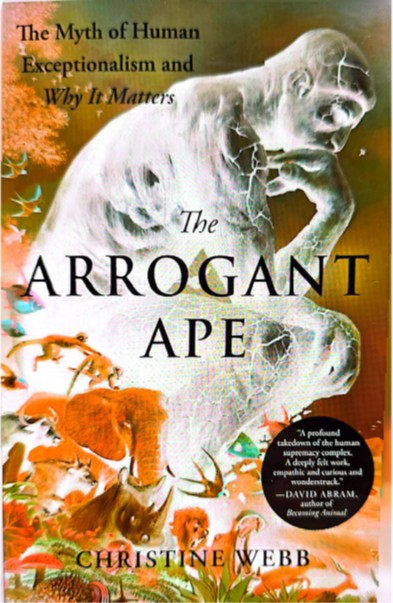
I will use my new website to comment on issues I intend to raise and respond to. Here is a case in point. Rarely are conservationists asked to review books about our views on nature and conservation. Most such books are written and reviewed by academics in the global North. They play an inordinate role shaping public opinions and conservation philosophy. Yet seldom do they capture the varied and changing views of nature and conservation practices among cultures, especially in the biodiversity-rich South. Christine Webb’s The Arrogant Ape. The Myth of Human Exceptionalism and Why It Matters (Avery, Penguin. N.Y. 2025) is a case in point. Webb urges us to discard the Western views of human domination, exploitation and the destruction of nature that comes of seeing ourselves as smarter and more valuable than other species. Instead, we should ditch arrogance for humility, awe and hope–and learn from traditional societies how to live with nature.
While I agree with the mechanistic view of science and biblical invocation of man’s dominion setting us above other creatures, and fostering exploitation, neither account for the exceptionalism she aims to dismantle. Webb ignores how the custodianship of God’s creation in the Bible, the Enlightenment scientific discoveries, the Romantic Movement in Europe, and John Stuart Mills intrinsic rights of animals, gave us our modern sensibilities of nature and its protection.
The exceptionalist view is not unique to the West. Creation myths around the world portray a higher being creating tribal ancestors and bequeathing them animals and plants for their use. Conflating the mottled Western views of nature into a single narrative of exceptionalism–as opposed to traditional society views based on reciprocity with other creatures–creates a false dichotomy.
 I agree with Webb’s point about the fallacy of seeing animals as inferior and less intelligent. Bats developed radar for tracking and preying on insects long before we developed sonar to track enemy aircraft and submarines. Birds millions of years ago developed the GPS navigational skills we only invented in the last few decades.
As Webb shows so well, each species has its own umwelt and unique traits for navigating its place in the world. Webb is also right about animals suffering cruel needless harm in scientific experiments, on industrial farms, as beasts of burden, and as commodities in the live animal and trophy trade. We need compassion and knowledge to see other species as beings with their own special traits, she argues. Yet, blaming human arrogance and exceptionalism as the cause of animal suffering and destruction misses the deeper evolutionary self-interest we share with all species.
Every species uses other species for its own ends, whether for food or materials. The hunting wasp paralyses and uses caterpillars as host and food for its eggs. Elephants knock down trees to get at the terminal branches, killing nestlings in the process. Cheetahs allow their cubs to batter around helpless gazelle calves to learn how to hunt and kill.
We are not alone in seeing ourselves at the center of life either. We are species-centric like other creatures. Anthropomorphism is our own species-centrism, no less than wasp-centrism elephant-centrism and cheetah-centrism. Even with our own kind, we are kin, clan, tribe and nation-centric. Our history is fraught with enslavement, genocide, and cruelty of the “other” no less than other creatures.
Webb sees our human exceptionalism as a product of western beliefs, exploitation and destruction. Neither is the case in my experience studying our emergence as a species in the African savannas, and the ecology of traditional societies over the last six decades (see We Alone. How Humans Have Conquered the Planet and Can Also Save It). As Charles Lyell, Darwin’s mentor wrote in 1833, “In thus obtaining possession of the Earth by conquest and fending our acquisition by force, we exercise no exclusive prerogative. Like other creatures, we unconsciously contribute to extend or limit the geographical range and number of certain species, in obedience to general rules in the economy of nature”. Darwin fleshed out the economy of nature as natural selection in his theory of evolution.
If domination of one species over another is not unique to us, our scale of our ecological impact and destruction certainly is. Humans in the Americas, Eurasia and Africa, exterminated the mega-mammals long before the rise of modern nation states. In domesticating plants and animals, pre-industrial societies from the Mediterranean to Mesoamerica and Asia turned natural habitats into farms, ranches and settlements, and degraded the land. The extermination of the megamammals and domestication changed the face of the earth and made us the supreme ecologically dominant species we are.
Yet in the process of eradicating other species and destroying the earth, traditional pastoral and farming societies laid the foundation of land husbandry, animal and plant science, and conservation. Here Webb has a good point. We have much to relearn about husbanding the land from successful communities. I’ve spent decades championing and promoting the lessons of community-based conservation for protecting wildlife and biodiversity (Natural Connections. Perspectives in Community-based Conservation). Kenya, and nations across Africa, have adopted community-based conservation policies to find space for wildlife under local custodianship.
I share Web’s call for humility and expanding our values of nature beyond utility and the economist’s GDP-driven growth models. Ironically, though, it is our unique human traits, our human exceptionalism among species, which give us the new-found sensibilities Webb calls for. At the pinnacle of our ecological success and domination, we are bucking Lyell’s law by conserving the big dangerous species we drove to verge of extinction—the whales, elephants, wolf, tiger and lion. What other species has or would conserve other species in becoming as dominant as we are?
Conserving other species for their own sake is an evolutionary novelty and aberration unique to us. The novelty arises from a set of traits which allow us to communicate and cooperate on a global scale, take stock of our destruction, and forge international agreements to conserve the diversity and planetary support systems. These are unique modern sensibilities arising out of our emancipation from the ecological straight-jacket of other species, new knowledge about life, how we evolved, and international compacts for conserving biodiversity. Conserving biodiversity elevates us above the selfish gene, kinship, tribalism and nationalism to a new plane of altruism.
For Webb, in one sense every species is unique. So why not us? Shirley Strum, who has studied baboons for over 50 years, wrote about how almost human they are, and yet how unique we in rising above the biological constraints limiting other species (Shirley Strum. Echoes of Our Origins. Baboons, Humans and Nature).
Why not use our exceptional traits to reverse the tide of destruction? Why not use what we have learned from the lessons of successfully societies managing the commons (Elinor Ostrom. Governing the Commons), and our newly emerging sensibilities which owe much to biblical custodianship and scientific discovery. Anthropocentrism doesn’t mean we need be arrogant or debase and destroy other species. To the contrary, the evolving conservation story Webb misses is that our modern sensibilities for other species has fashioned global accords seeing them as vital to our own wellbeing and future of the planet.